
Rupp Debate thriving in online competitions
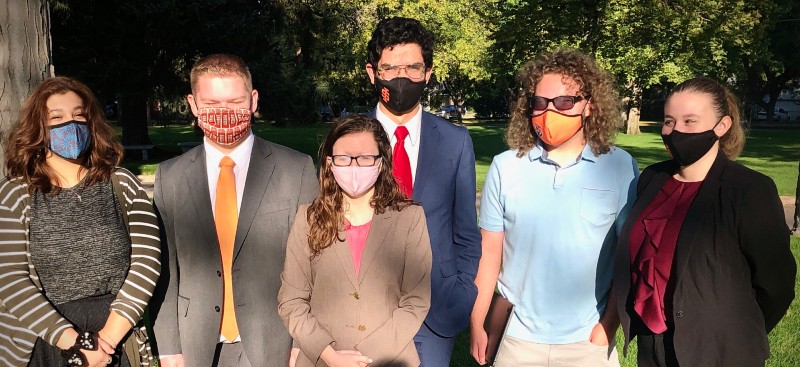
In a semester defined by virtual events and constant Zoom meetings, Idaho State’s Rupp Debate team has found success during an online season.
The team has claimed top honors in multiple online speech and debate competitions, setting itself up as a serious contender at the national level.
“We’ve been debating online periodically for about five years now, so in many ways we have a little advantage in the COVID era,” said Andy Christensen, assistant coach. “Our experience with some of the technology, with making persuasive arguments on the virtual stage and with handling competitors who aren’t in the same room is evident in all these speaking honors the squad is picking up.”
Rupp Debate is currently engaged in a two-week online public speaking tournament hosted by the Northern California Forensics Association, and will return to live action online November 1. It will also host a public debate online in November in honor of the 100th anniversary of the women’s suffrage movement.
Earlier this month, the team talked its way into semifinal and quarterfinal rounds in debate and placed fifth in an individual contest this month at the Steve Hunt Classic, hosted by Lewis & Clark College and Whitworth Universities. More than 70 colleges and universities from 27 states were represented, with a dozen individual events and five types of debate offered.
Abbey Vaughn, a Twin Falls junior majoring in special education, placed fifth in Programmed Oral Interpretation. Vaughn’s work is a project piece based on the works of Gabiola Rodriguez. Vaughn also placed in the top ten amongst Junior Extemporaneous entries.
Joseph Tyler, an Idaho Falls sophomore in computer science, ranked fourth in Senior Extemporaneous speaking.
Senior Kaden Marchetti was defeated in a split-decision semifinal in the senior division of International Parliamentary debate. Marchetti studies computer science and was the British Parliamentary champion at this tournament in 2019. Abbey Vaughn also advanced to the quarterfinal round in junior International Parliamentary debate.
Speakers Jett Smith, a communication major from Pocatello, and Colter Barker, a freshman studying computer science, reached the British Parliamentary round. Barker was the seventh place novice speaker tournament-wide.
Regional debate tournaments typically hosting 15 or 20 colleges are quickly becoming large-scale competitions as online competitions have replaced face-to-face tournaments this fall. ISU is a serious contender early in the forensic year, with ISU debate coach Sarah Partlow-Lefevre noting “they’re competing well at the national level.”
In September, the squad roared through round after round of online speech and debate competitions at the Fran Tanner Open hosted by the College of Southern Idaho in Twin Falls.
Joseph Tyler claimed gold in the final round of Extemporaneous speaking. Contestants are provided with three topics to choose from and 30 minutes to prepare a topical, well-supported presentation. Approximately 75 students entered the extemporaneous speaking competition.
Rupp Debate entered three teams in the International Public Debate competition. Senior Jett Smith and freshman Colter Barker claimed varsity gold, and the team of sophomores Joseph Tyler and Alyson Tyler claimed silver. In the novice bracket, the Bengals team of Madison Pritchard and Donna Paurevic, both freshmen from Twin Falls, claimed the gold.
Novice speaker Paurevic was awarded gold speaker honors, accompanied by her team partner Pritchard, who won bronze for third. Both women are from Twin Falls and are majoring in political science. Varsity speakers Joseph Tyler, Jett Smith and Colter Barker, all Pocatello residents, claimed gold, silver and bronze for their speaking prowess.
The debaters argued topics including “The US should ban companies from using facial recognition technology,” “The Federal minimum wage should be increased,” “Alternative energy can effectively replace fossil fuels” and others.
Unique to the IPDA debate forum is that the two teams are provided five topics and then “strike” – or eliminate them – until only one remains to argue. Each team has 30 minutes to prepare. A new topic is selected from different options for each round of competition.
Over 250 entries from 19 universities convened for the two-day event. Most registered colleges were from the Pacific Northwest; the tournament newcomer was Seton Hall University from New Jersey.
The ISU Rupp Debate squad is generously supported by James M. and Sharon E. Rupp, the College of Arts and Letters, the Department of Communication, Media, and Persuasion and ASISU.
Story by Andy Christensen and editing by Madison Shumway